
Warm-Season Grasses: Every Detail You Should Know
Helping Homeowners in the South Understand Their Lawn
Warm-season grasses thrive in the South because they’re built to handle warmer temperatures and more frequent droughts. They also have the unique ability to keep a green color throughout it all…if they’re getting enough water.
But there’s so much more to know about this kind of turf. The good, the bad, and the unique. So continue reading to find some mowing tips, watering advice, an identification how-to, and more. After all, learning the ins and outs of your warm-season grass and trusting Green Queen can help your lawn stay healthy season after season.
What’s the Ideal Location for Warm-Season Grasses?
This turf variety does best in the bottom third of the U.S. Seriously hot and dry weather is what warm-grasses have evolved to easily handle. On the flip side of the temperature gauge, these grasses like areas with milder winters, so the grass can remain in good shape even in colder weather.
Just north of where warm-grasses thrive is the Transition Zone. It’s the sweet spot in the middle of the country where winters too cold for warm-season grasses and summers get too hot for cool-season grasses. The result? A difficult time for homeowners. They may have to choose between brown grass in summer or winte. It simply comes down to the region, temperature, and grass type.
The Transition Zone often has tall fescue or zoysia to handle the extreme temperature swings. It’s not perfect, but it’s better than an ugly yard that’s struggling with one weather extreme or another.
Top Kinds of Warm-Season Grass
Zoysia has a few varieties, with homeowners appreciating it because for its thickness, which crowds out weeds, and the relatively soft texture. Zoysia does well in sunlight and okay in partial shade. Definitely better than Bermuda. Plus, it’s flexible, meaning it grows in different kinds of soil, from clay to sand.
It grows more slowly though, especially compared to another grass like Bermuda. However, a slow-growing grass leads to fewer mowings during the year. In other words, it’s not as high-maintenance as other options. Additionally, some varieties of zoysia are more cold-tolerant than other warm-season grasses, making it a great choice for those in the Transition Zone.
St. Augustine has a coarse texture due to its wider blades. It’s the best warm-season grass for shaded areas, so yards with large trees do well with St. Augustine, which spreads through stolons and establishes itself easily.
The biggest drawback of St. Augustine? It requires more water than other turf types to look its best. And it also doesn’t take heavy traffic quite as well. In humid climates, certain pests and diseases (chinch bugs and brown patch fungus) really prefer St. Augustine.
Bermuda is one of the most-carpet-like grasses in the South. Sun and foot traffic are no big deal because Bermuda handles them both easily.
The one main thing to know is that Bermuda needs regular upkeep: mowing, fertilizing, and watering. Another positive about this variety of warm-season grass? It spreads by underground stems called rhizomes and above-ground runners called stolons, so it bounces back quickly when damaged. It’s fairly drought-tolerant once established but goes dormant and turns brown in winter when temperatures drop below 50°F.
Can you *and should you) mix grass types? With warm-season grasses, combining grasses usually doesn’t work as well as it does with cool-season varieties. Bermuda is aggressive and will eventually choke out zoysia or St. Augustine, so it’s not recommended.
Of course, you might find Bermuda and zoysia grasses growing side by side in a lawn, but Bermuda tends to dominate in sunny spots, while zoysia hangs on in shady areas.
What’s the Definition of a Warm-Season Grass?
Southern homeowners often notice their yards look the best in late spring through early fall. The how and why of that is simple: warm-season grasses. As mentioned previously, these types of grass do well when temperatures are between 80-95° F.
Warm-season grasses photosynthesize differently than their cool-season cousins. They prefer hotter temperatures, helping them deal well with intense heat, full sun, and drought conditions. In addition, they go dormant when the cold weather arrives. Many types remain green, while some turn brown in winter and stay alive underground.
Warm-Season Grass Identification Guide
Interested in what type of grass your yardh has? Read through these quick tips to get a better idea.
- Color and texture: St. Augustine is blue-green and coarse to the touch. Bermuda is dark green to gray-green and soft. Zoysia is medium to dark green and has a dense, carpetlike feel that’s stiffer than Bermuda.
- Growth habit: Bermuda spreads aggressively through both rhizomes and stolon. That means, for good or bad, it can take over a lawn quickly. St. Augustine spreads only through stolons that run above ground and root at the nodes. Zoysia spreads through both rhizomes and stolons but grows more slowly than Bermuda.
- Seedhead: Bermuda produces a distinctive seedhead with 3-7 finger-like spikes radiating from a central point. St. Augustine rarely produces seedheads in mowed lawns. Zoysia produces small, fine seedheads that stick up like tiny brushes, though many varieties don’t seed much.
- Ligule and auricles: St. Augustine has a fringe of hairs where the blade meets the stem instead of a membrane. Bermuda has a ring of white hairs at the ligule. Zoysia has short hairs along the ligule. None of these grasses have prominent auricles.
- Leaf blade: The width and texture of the blade is to be checked. St. Augustine has the widest blades of the three, about 1/4 to 1/2 inch across with rounded tips. Bermuda has fine, narrow blades with a pointed tip. Zoysia falls in the middle with medium-width blades that feel stiff to the touch.
It’s really not that hard to differentiate grasses from one another, especially if you take the time to look closely at them. Still curious about what’s growing in your yard? Ask one of the lawn care experts at Green Queen. We can assist in identifying your grass.
When to Water Warm-Season Lawns
The heat in the South has made warm-season grass the unique turf that it is. For instance, it’s far more drought-tolerant than cool-season grass. Actually, warm-seasons grasses can use about 20 percent less water. In summer, that’s a really big difference.
But how much should you water in the South? In general, most warm-season lawns need between 1 and 2 inches of water per week. The amounts will vary depending on sun exposure, soil type, and local weather.
For example, full-sun lawns usually need about 2 inches per week during the growing season. However, if your lawn receives partial shade and sun, aim for about 1 inch. The heavily shaded ones may need even less.
The best method for watering warm-season grasses? Water once a week deeply, rather than lightly each day. You want to deliver water right down to the roots of these (6 to 8 inches deep). It seems counterintuitive, but that’s the best way to do it!
Many people water every day but not very much. That’s not a great formula. It weakens roots, making the grass less drought-tolerant and easier for fungus and weeds to attack.
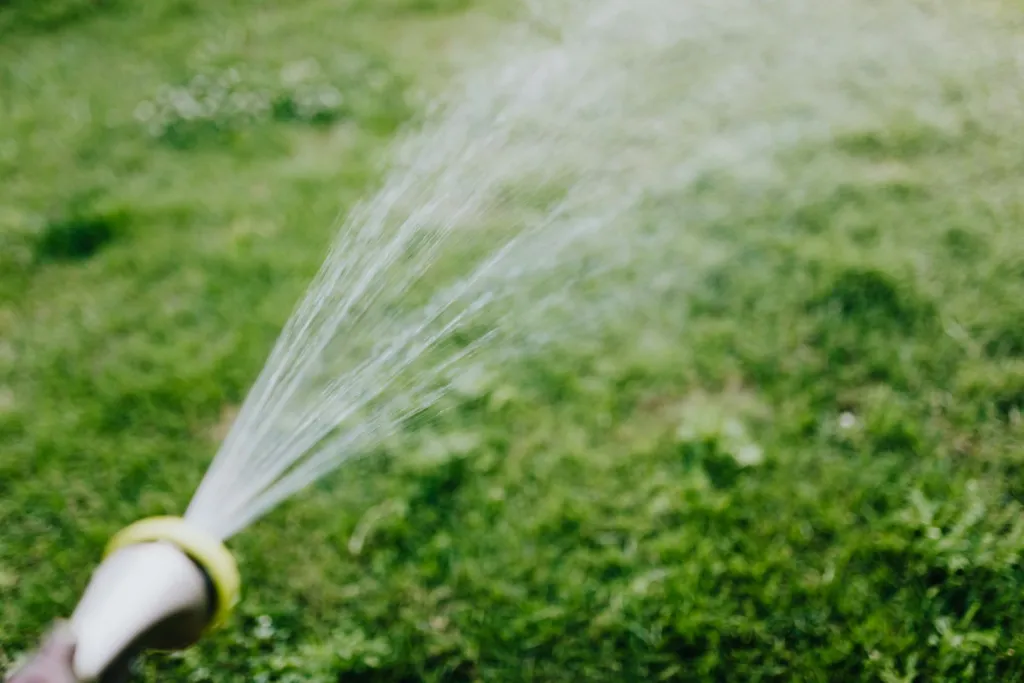
The best time to water grass? Between 4 and 8 a.m. Water pressure is strongest, wind doesn’t disrupt the spray pattern, and you lose almost nothing to evaporation. If you can’t water that early, the next best time is 8 a.m. to noon.
Keep in mind that clay soils hold water longer, while sandy soils drain quickly. You may want to adjust your schedule to accommodate watering more or less depending on your specific soil type.
And keep in mind that when it really heats up during summer, your warm-season grass may go dormant and require even less water. It will naturally turn a golden-brown color until the cooler temperatures return.
Warm-Season Lawns & Fertilizer
When should you apply fertilizer to warm-season grasses? When they’re growing! So late spring through the summer. This takes advantage of the peak performance months, helps maintain density, and keeps your lawn healthy and looking picture-perfect.
Keep in mind that nitrogen is the best friend of established lawns. It promotes leaf development and that eye-catching green color everyone loves. For new lawns, phosphorus and potassium are a bigger deal since they help with root and stem development.
Avoid fertilizing warm-season grasses in early spring when they’re still dormant or just beginning to wake up. Wait until soil temperatures reach 65°F and your grass is actively growing. Also, skip fertilization after late summer. Feeding too late in the season can make your grass more vulnerable to damage in colder weather.
In general, fertilizer helps turf stay dense, which reduces weeds. Non-fertilized grass isn’t as thick, which allows weeds to take over your yard.
4 Issues You May Have With a Warm-Season Lawn
- Fungal diseases are common in the warm-season grasses, particularly in hot and humid areas of the South. St. Augustine and Zoysia are susceptible to brown patch and gray leaf spot, while Bermuda grass can be affected by dollar spot and spring dead spot. These usually look like circular brown patches, thinning areas, or discolored turf. The easiest ways to prevent lawn disease in the South? Proper lawn maintenance. Water in the early morning, mow at the right height, avoid over-fertilizing during peak heat, and watch your lawn drainage.
- Nutrient lockout can sometimes cause yellowing or poor growth in grass growing in acidic southern soils. A soil test will determine the exact deficiencies and pH problems. Lime applications raise pH where needed and sulfur lowers it (if you’re in an area with alkaline soil).
- Pest infestations. Grubs and chinch bugs can quickly (and silently) destroy your yard. These insects feed on the grass, weakening or destroying it in days or even hours. A few telltale signs of a lawn pest issue include wilting, yellowing, or dead patches
- Compaction and thatch. This creates a handful of problems, especially in heavy clay soils. Aeration in late spring or early summer, when your grass is actively growing, helps to alleviate these issues while allowing the lawn to recover quickly.
To Love or to Hate Thatch?
Be sure to pay attention to how much thatch you have. It’s the often overlooked layer of organic material that builds up right above the soil.
A small amount of thatch is okay since it moderates soil temperature and provides cushioning. However, too much thatch blocks air and water, so fertilizer isn’t worthwhile and diseases and pests can hurt your yard.
Actually, watering too much, fertilizing too much, and having compacted soil can worsen your thatch issue. Roots develop in the thatch layer instead of soil when it gets too heavy. Since thatch carries little water, your lawn is subject to heat stress, cold stress, and drought stress.
Eliminate the Crabgrass & Weeds
Pre-emergent herbicides are the best way to tackle crabgrass and other pesky weeds before they rear their ugly heads. This kind of herbicide prevents summer annual weeds from germinating.
Apply it when soil temperatures are between 55 and 60°F (usually mid-February through early March). Miss this window of time and you could be fighting crabgrass all summer.
Already seeing weeds pop up? Post-emergence herbicides kill the actively growing ones. The best time for spot-spraying broadleaf weeds like dollar weed, clover, and dandelions is from late spring to early summer. That’s when they will more easily absorb the herbicide.
Also, fall treatments can be effective. As temperatures drop, plants take up nutrients in preparation for winter dormancy.
How to Mow Warm-Season Grasses
- Leave clippings on the lawn. Bagging clippings is time-consuming and depletes the nutrients in your lawn. Mulching mowers and side-discharge mowers do a good job of spreading the clippings out.
- Cut the right amount. Don’t remove more than one-third of the blade height at a time. If your mower is set at 3 inches, mow when the grass reaches 4 inches.
- Change your frequency with the seasons. In spring, mowing two times per week may be necessary. In summer, every two to three weeks is usually the right amount since growth slows down a bit.
- Follow these mowing tips for better results. When you mow too low, it hurts root development and lets insects, disease, dryness, and foot traffic make a bigger impact. Plus, it allows weeds to infiltrate your yard.
- Keep the sun in mind. If your lawn is shaded, mow 0.5 to 1 inch higher than usual.
- Maintain sharp blades. The sharper the blade, the better the cut. Dull blades can provide more opportunities for fungal diseases to take hold.
Interested in learning more about proper mowing? Check out these mowing recommendations from Texas A&M AgriLife Extension.

FAQs About Warm-Season Grasses
Can I grow warm-season grass in winter?
It is not the best idea to plant warm-season grass in winter, as it requires warm soil temperatures, around 65° Fahrenheit or higher, to germinate and establish. The perfect time to plant it would be from late spring to early summer when the soil is warm, and your grass gets the entire growing season to build strong roots.
Can I mix cool- and warm-season grasses?
Because of the difference in their growth patterns and seasonal preferences, mixing both warm- and cool-season grasses into one lawn is not advisable. The end result would be a spotty, inconsistent lawn.
What’s the best grass for shaded areas?
Among the warm-season turfgrasses, St. Augustine grass is more tolerant to shade, with zoysia being the closest to it. Remember that by nature, grasses prefer sunlight. Therefore, no grass does outstandingly well under dense shade when it receives less than 4 to 6 hours of sun per day.
How long does grass seed take to grow?
It depends on the variety. In general, Bermuda grass germinates within 7-14 days and some grasses like bahia take longer (21-30 days). Of course, it all depends on soil temperature and moisture levels. Note that many southern homeowners choose sod or plugs over seed for faster establishment, especially with St. Augustine and zoysia.
We Know Warm-Season Grass
The proper way to care for warm-season grasses includes watering, mowing, and fertilizing at the exact right times and in the right amounts. That’s how you create a healthy yard! So hopefully a few of these lawn care tips have helped.
If you don’t want to use your free time (and energy) to take care of every little lawn care detail, reach out to Green Queen today to learn more about eco pest control and lawn care! We proudly offer these services to the following areas: