
Stunning Details About the Life Cycle of Mayflies
Discover How Long Mayflies Live & How to Discourage Them
Mayflies are surprising in a number of ways. These small, winged insects seem to show up out of nowhere, sometimes in huge numbers. They live short lives but can create a huge mess. And the ways they bother homeowners are different from what you’d expect.
If you want to understand what these insects actually are and whether they’re worth worrying about, the pest control team at Green Queen has the full picture. Here’s what brings mayflies to your property, how long they last, and what actually helps.
Should You Worry About Mayflies?
Not from a health standpoint. Due to their anatomy, mayflies are genuinely incapable of biting or stinging. Adult mayflies have mouthparts that serve no function. Their digestive systems are similarly non-operational. There is no feeding, no venom production, and no mechanism for delivering either a bite or a sting.
If you walked through a mayfly swarm and came away with welts, something else is responsible. Mosquitoes and midges commonly emerge under the same conditions and share the same airspace during peak swarm events. In a thick, disorienting cloud of insects, it’s easy to assume the culprit is whatever species is most visible. However, the biter was almost certainly something else.
As for disease, that’s also not a concern with mayflies because they don’t carry or transmit any pathogens. Their impact on human health is essentially zero. The practical annoyances (insects in your hair, carcasses coating your driveway, the faint odor as things decompose) are real enough, but they’re inconveniences, not health risks.
What Exactly Is a Mayfly?
The name is the first source of confusion. Despite what it implies, mayflies are not flies in the traditional sense. They belong to a group far more closely related to dragonflies than to houseflies, mosquitoes, or any of the other insects most people think of when they hear the word “fly.” You might also know them as shadflies, lakeflies, or dayflies, depending on your region.
One aspect of mayflies that surprises most people is their ecological importance. In the South and elsewhere, mayflies are a cornerstone food source for fish, birds, and bats. Environmental scientists actually monitor mayfly populations as a water quality indicator. A healthy, substantial emergence is generally evidence that the surrounding water is clean.
Identifying a mayfly:
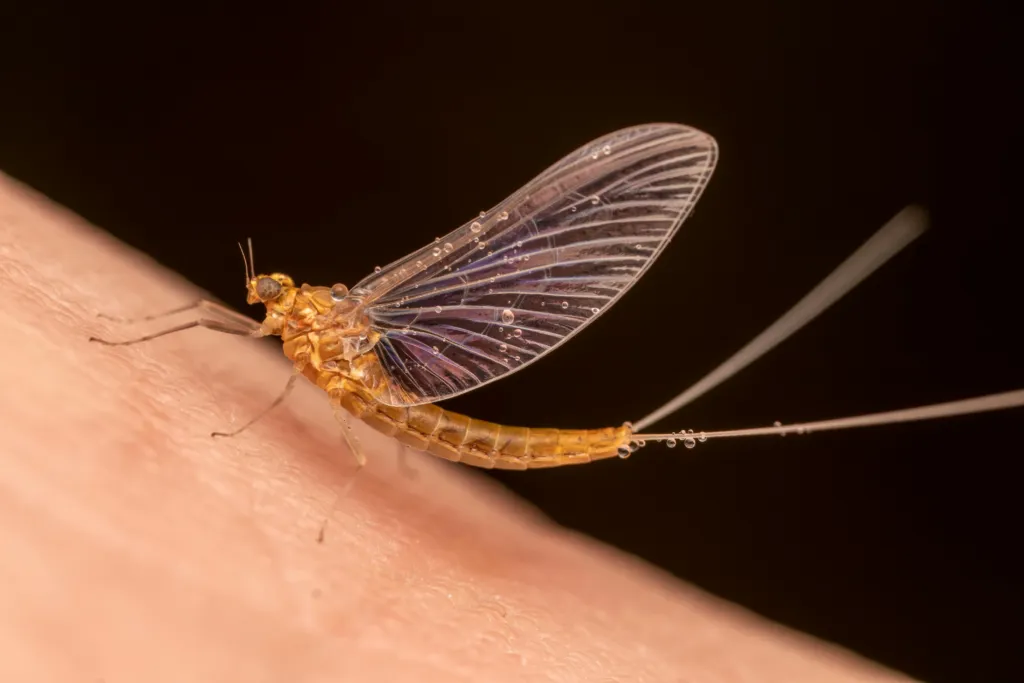
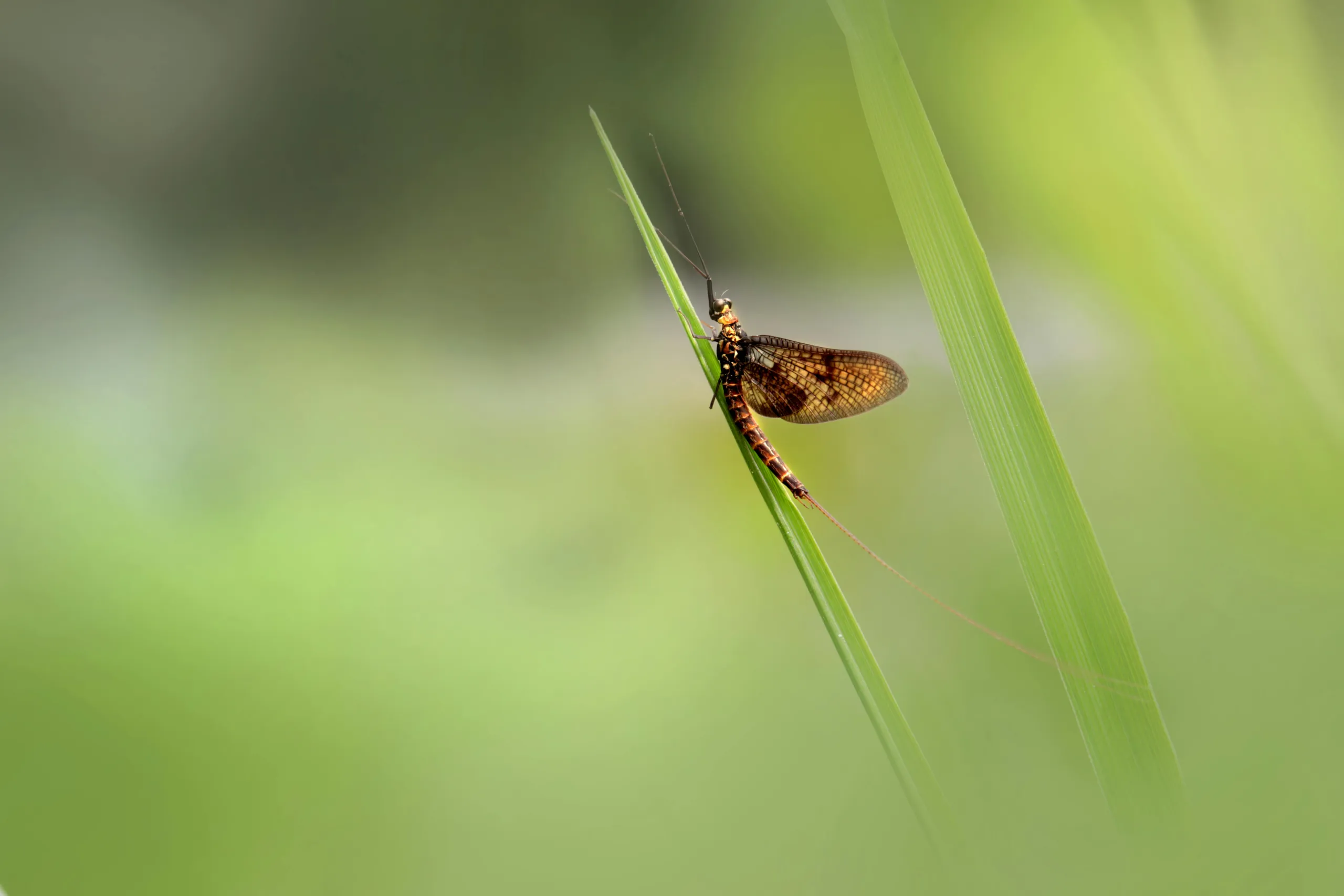
The upright wings are the most immediately recognizable feature. At rest, mayfly wings angle sharply upward rather than folding flat. The long tail threads trailing from the abdomen are the second key marker.
Comparing to similar insects:
- Mosquitoes have a thin, needle-like proboscis designed for piercing skin. Mayflies have no mouthparts capable of feeding whatsoever.
- Crane flies are significantly larger, with long spindly legs and wings that rest horizontally. The upright wing position and tail filaments are reliable ways to distinguish a mayfly from either.
Mayfly nymphs (the underwater juvenile stage) look completely unlike the adults. They’re stockier, darker, and with visible gill structures running along the abdomen.
Adults look far different:
- Body length from about ¼ inch to just over 1 inch
- Long, slender abdomen tapering to a narrow point
- Two or three cerci (tail filaments) extending from the rear
- Four translucent, veined wings held upright when not in flight
- Disproportionately large compound eyes
How Long Do Mayflies Live?
The mayfly lifespan is one of the more striking contrasts in the insect world. It starts with a years-long hidden chapter, followed by an adult stage that’s over in a couple of days or less.
Nymph stage
The overwhelming majority of a mayfly’s life takes place beneath the water’s surface, invisible to anyone watching from the shore. Nymphs burrow into sediment and graze on algae, organic debris, and decomposing plant material in rivers, streams, lakes, and ponds. Depending on the species and environmental conditions, this stage lasts anywhere from a few months to two full years, involving dozens of molts as the insect develops.
Adult stage
Once emergence begins, the clock is running. Most adult mayflies live between 12 and 48 hours. They don’t eat or bite. From the moment they leave the water, every hour is directed toward finding a mate and reproducing before time runs out.
Essentially, the part of a mayfly’s life that’s happening right under your feet in nearby waterways can span years. The part you actually witness lasts less than two days.
More Life Cycle Details
Eggs deposited on the water surface sink and settle into the sediment below, where they hatch into aquatic nymphs. Over months or years, those nymphs develop. When environmental conditions reach the right combination of water temperature, little wind, and seasonal cues, thousands of nymphs trigger their emergence simultaneously.
They swim to the surface, shed their larval casing, and launch into the air as winged subadults. Within a matter of hours, they undergo one final molt into fully mature adults and swarming begins.
Keep in mind that a single female can deposit between 500 and 8,000 eggs onto the water surface, depending on body size and species. Those eggs sink, and the entire cycle starts over.
The synchronization of mayfly emergence is what creates the visual drama. Thousands start to fly around at the same time in the same location. Add warm and still evening air plus a nearby light source, and the result is the kind of scene that sends people reaching for their phones to call us.
Year-to-year variation is driven by a combination of factors: the previous winter’s temperatures, larval survival rates, water quality during the nymph stage, and the weather in the weeks leading up to emergence. A mild winter and a warm, wet spring frequently produce unusually large hatches.
What Pulls Mayflies to Your Property?
- Water nearby. Nothing matters more than location. Properties within about a mile of a lake, river, or pond during emergence season are directly within the range of any swarm originating from that waterway.
- Surfaces that reflect light. Mayflies appear to mistake certain reflected light signatures for water. A glossy car, a swimming pool with overhead lights, or polished siding can all trigger a landing response even when you’re not particularly close to natural water.
- Mild, still evenings. Wind is one of the few things that reliably suppresses emergence activity. When the air calms and temperatures are comfortable, that’s when swarms materialize. Watch the forecast. Conditions that feel pleasant to you feel perfect to a mayfly.
- Outdoor lighting with a broad spectrum. White and blue-spectrum bulbs are among the most powerful attractants you can have on your property. Switching to warmer amber or yellow LED alternatives meaningfully reduces that draw, even if it doesn’t eliminate it entirely.
When Does Mayfly Season Hit?
The broad window is late spring through summer, but geography shapes the specific timing significantly.
The South: The warmer water temperatures that persist through winter and early spring push emergence ahead of schedule. Peak activity typically arrives in April or May, which is earlier than nearly anywhere else in the country.
Midwest & Great Lakes region: The most dramatic swarms tend to occur from late May through July, concentrated along major rivers and the coastlines of the Great Lakes. Some communities along Lake Erie have experienced emergences dense enough to close roads.
Northern states: Mayfly season arrives later and tends to compress into a more concentrated, shorter burst of activity.
Evening conditions are the trigger. Still air and mild temperatures are what initiate large-scale emergence events. A passing cold front can shut things down almost immediately, but the interruption is usually temporary. Once temperatures climb back up and the wind drops, activity resumes.
Where Do Mayflies Appear Near Homes in the South?
Freshwater is the constant. Mayfly nymphs require clean rivers, streams, lakes, and ponds for development, and the presence of mayflies in good numbers near any waterway is generally a positive sign about that water’s ecological condition. Polluted or heavily degraded waterways tend to lose their mayfly populations early.
Once adults emerge, they don’t venture far. Weak on the wing and heavily influenced by light, they tend to concentrate wherever artificial lighting pulls them. That’s why waterfront properties and neighborhoods near lakes or ponds bear the brunt of swarm activity. Common gathering points around homes include:
- Exterior lighting. Bright white or older mercury vapor fixtures that broadcast a wide spectrum are especially appealing to mayflies.
- Vehicles. Smooth, reflective surfaces appeal to them for reasons tied to how they perceive water.
- Siding and windows. Mayflies can end up on vertical surfaces in large numbers during peak emergence.
- Pool decks, patios, and docks. These areas see increased activity in evening hours when emergence is most active.
What Kind of Damage Can Mayflies Cause?
Should you worry about mayflies harming people or property? Not at all. But calling them completely benign sells the nuisance short.
The issue is scale. Dead mayflies accumulate rapidly. As they break down, they produce an unpleasant odor. Plus, a significant buildup on pavement, porch steps, or sidewalks becomes a genuine slip hazard, particularly on smooth or polished surfaces. Leave the debris too long and you’ll attract birds and bats moving in to scavenge, which introduces a new set of complications.
A heavy mayfly swarm won’t damage your home, your health, or your lawn. However, it absolutely has the potential to render your outdoor spaces unusable for a day or two.
Is It a Mayfly? Or Something Else?
Crane flies are the elongated, slow-moving insects sometimes called “giant mosquitoes.” They’re larger than mayflies, their wings lie flat at rest, and they lack the vertical wing position and tail filaments. Harmless to people, though their larvae can occasionally stress turf.
Mosquitoes are the most commonly confused species, especially during swarms. The clearest distinction: mosquitoes bite, while mayflies can’t. Mosquitoes hold their wings flat against their bodies; mayflies hold theirs upright. The narrow, pointed proboscis of a mosquito is visible up close, and mayflies have nothing like that.
If you’re dealing with mosquitoes, reach out to Green Queen for eco-friendly mosquito control!
Midges are small, abundant near water, and frequently mistaken for mayflies. Critically, certain midge species do bite. If bites and welts are part of your experience, midges are almost certainly the culprit, not mayflies.
What to Do When Mayflies Show Up
Unfortunately, the breeding source (underwater across lakes, rivers, and ponds) isn’t something that’s easily dealt with. The strategy here is damage control and reduction, not eradication.
Clean up promptly. Once a swarm passes, move quickly. A broom, shop vacuum, or hose takes care of most of the carcasses, and acting before decomposition sets in keeps odor to a minimum and eliminates the slip hazard.
Adjust your lighting. Switching from bright white bulbs to warm amber or yellow LEDs removes one of the biggest draws to your property. Motion-activated fixtures help by limiting how long lights run during peak emergence hours. Pointing fixtures downward reduces how far light disperses. During the worst nights of a heavy emergence, shutting off outdoor lighting entirely remains the single most effective thing you can do.
Reduce other attractants.
- Check all window and door screens for any openings that could let insects inside
- Close blinds and curtains near exterior windows once evening hits
- A fan positioned on a porch or patio creates air movement mayflies struggle to navigate through
- Keep decorative water features in mind since they can attract egg-laying females
What about insecticides? Since they’re largely ineffective, it’s usually not worth using them. The adult window is so short that most products don’t have time to make a dent before the swarm ends naturally. Also, applying pesticides near water sources carries environmental risks that aren’t justified by the results against an insect that poses no real threat.
Targeted treatments can occasionally make sense for commercial situations involving severe recurring swarms. But for the average homeowner, light management and quick cleanup outperform anything that comes from a spray can.
When Does It Make Sense to Call a Professional?
The majority of mayfly swarms resolve within a few days without any intervention. That said, professional help has real value in a few specific situations:
- Severe swarms that return annually and significantly affect how you use your outdoor spaces, despite your own management efforts
- Commercial properties where insect accumulation creates documented safety hazards in high-traffic areas
- Situations where you’re genuinely uncertain whether you’re dealing with mayflies or mosquitoes: professional identification removes the guesswork
Green Queen can evaluate your specific circumstances, determine whether other contributing factors are at play, and develop an integrated pest management approach suited to your property.
Quick Answers
-
How long does a swarm last?
Usually one to three days at peak intensity. Some events stretch to about a week when multiple species are hatching in overlapping waves.
-
Does a mayfly swarm mean nearby water is dirty?
Counterintuitively, no. A thriving mayfly population typically signals clean water. They’re considered a bioindicator of aquatic health.
-
Why do mayflies come to lights?
They use natural light for orientation. Artificial sources interfere with that system, pulling them toward the light.
-
Can they establish themselves inside my home?
No. Mayflies don’t breed indoors and have no interest in any resource inside your house. They die quickly.
-
Do they eat plants or damage grass?
Adult mayflies are completely incapable of feeding. There is no lawn or plant damage to worry about.
Flying Insects Causing Problems? We’re Here!
Mayflies are manageable. Swap out the lighting, clean up the debris, and know that the event will pass on its own within a day or two. But when you’re not sure what you’re dealing with, or when seasonal pest pressure is affecting your ability to enjoy your outdoor spaces, Green Queen is ready to help.
If you don’t want to use your free time (and energy) to take care of lawn care or flying pests like mosquitoes, reach out to Green Queen today to learn more about eco pest control and lawn care! We proudly offer these services to the following areas: