
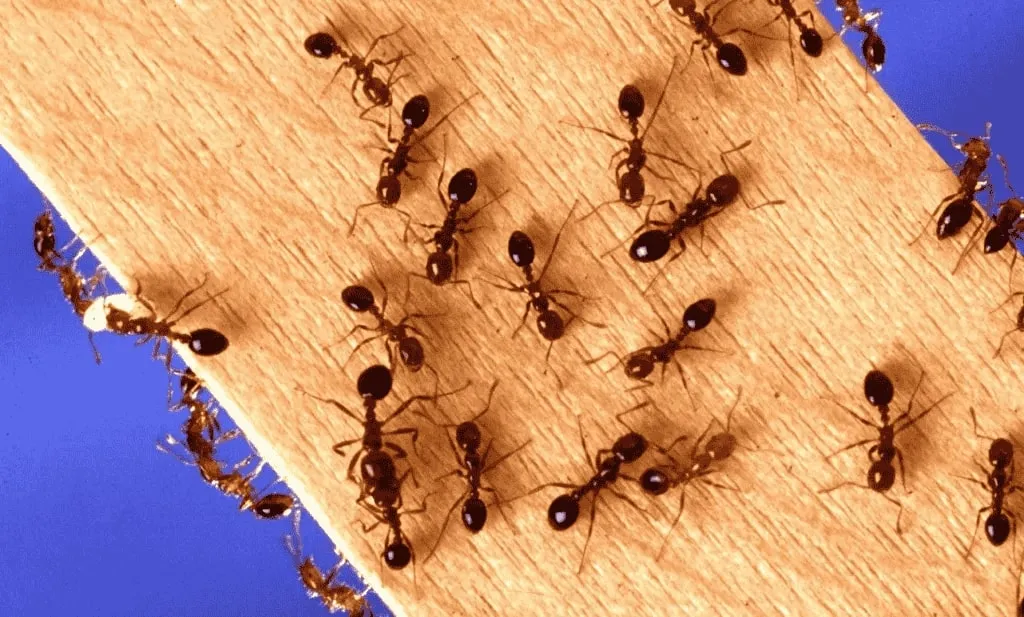
15 Types of Ants Southern Homeowners Deal With
Which Species Are Just Annoying or Actually Threatening?
30-Second Synopsis:
- Use this practical guide to identify common ant species by what you see, smell, and where they show up
- Learn what makes each type of ant distinct and how serious each one actually is
- Why spraying visible ants often makes things worse, and what works better instead
- Get prevention tips that reduce long-term ant pressure around your home
- Green Queen is ready to help with ant control services and lawn care solutions in the South
Four Clues to Figure Out the Ant Type
Where are they? Location is one of the most important factors. A raised dome-shaped mound in an open, sunny area of lawn suggests fire ants. A fine dusting of sawdust-like material near a baseboard or window frame points toward carpenter ants. Mud channels running along damp wood or near a plumbing leak are almost always moisture ants.
How do they move? Single-file columns are characteristic of odorous house ants and similar species. Ants moving in fast, scattered, seemingly random directions with no apparent organization are most likely crazy ants.
What do they look like? Pay attention to size, color, and body shape. Are they barely visible or noticeably large? Black, brown, reddish, or yellow? Does the abdomen look heart-shaped, elongated, or almost wasp-like?
What do they smell like? Weird as it sounds, crushing a single ant is a reliable identification tool. A rotten coconut scent means you’re probably looking at odorous house ants or ghost ants.
15 Ant Species You Might Encounter
Sugar Ant
“Sugar ant” is a catch-all term for several small household ant species. They’re typically 2 to 15 mm, brown to black or reddish. These ants show up around food residue and sweets.
Mostly nocturnal, they enter through any gap around doors, windows, or utility lines. Sanitation and exclusion are the foundation of control and bait traps along active trails work best.
Ghost Ant
About 1.5 mm, with pale legs and abdomen contrasting against a darker head, and a faint coconut odor when crushed. A serious pest in warm, humid climates, ghost ants enter through tiny gaps and gravitate toward kitchen and bathroom surfaces.
Their multi-queen structure (with queens regularly splitting off to establish new nest sites) makes DIY sprays unreliable. Professional baiting is usually necessary.
Fire Ant
Look for the raised, dome-shaped mound. It won’t have a visible surface opening and is almost always in open, sunny turf.
A single colony can hold up to 250,000 workers that sting rather than bite, injecting venom that causes burning welts. Spread granular bait around the mound rather than on top. Direct mound treatment disrupts foraging before workers can carry the bait back to the colony.
Twig Ant
Large, slender, and distinctively bicolored in orange and black, with oversized eyes that give them an almost wasp-like look.
They nest in hollow branches and woody stems and are most common in Florida, Texas, and throughout the South. Not aggressive unprovoked, but they sting when disturbed. Most encounters happen during pruning or yardwork near shrubs and trees.
Odorous House Ant
Small (1/16 to 1/8 inch), brown to black, and identifiable by the rotten coconut smell crushed workers release. One of the most common indoor ants in the country, they nest in wall voids, under sinks, and in damp soil near structures.
Spraying foraging workers pushes the colony to relocate rather than eliminating it. Patient baiting along active trails is the only approach that reaches the queen.
Crazy Ant (Caribbean Crazy Ant)
About 1/8 inch, covered in reddish-brown hairs, and instantly recognizable by their fast, erratic, zigzagging movement with no organized trail. Active outdoors year-round in the South, they push indoors after heavy rain or when fall food sources dry up.
Their multi-queen structure makes perimeter sprays nearly useless. Effective control relies on sealing entry points and using bait workers can carry back into the colony.
Acrobat Ant
Light brown to dark brownish-black, around 1/8 inch, with a heart-shaped abdomen that tilts upward when threatened.
They prefer moist or previously damaged wood and often follow existing carpenter ant galleries through walls. Correct the underlying moisture problem and the ants typically go with it.
Pavement Ant
Dark brown to nearly black, about 1/8 inch, found virtually everywhere in the country. They nest under stones and inside foundation cracks, pushing fine soil to the surface as they dig. Those small craters along sidewalk edges are a telltale sign.
Management is mostly environmental: seal foundation cracks, eliminate standing water, trim vegetation touching the house, and keep firewood away from exterior walls.
Field Ant
Large workers at 4 to 8 mm, typically red, black, or a combination, building wide flat mounds up to three or four feet across in open, sunny lawns and along fence lines.
Field ants bite and follow up with a formic acid spray, which makes disturbing a mound genuinely unpleasant. Treat active mounds with a granular or liquid drench product labeled specifically for mound applications.
Moisture Ant
About 1/8 inch, yellowish to dark brown, with a translucent abdomen. They nest in rotting or water-damaged wood and build mud channels connecting soil to wood surfaces.
Moisture ants are a symptom, not the root cause, so be sure to fix the water source first. Treating the ants without addressing what drew them there will only make the cycle repeat itself.
Army Ant
About 1/4 inch, dark brown to black with an orange-tinged abdomen and large mandibles. Unlike every other species here, army ants build no permanent nest. Millions of individuals form temporary living structures that sweep through an area before moving on.
Confined mostly to Florida, Texas, and the Gulf Coast, they won’t infest your home, but a raiding column moving through the yard is worth acting on.
Leafcutter Ant (Texas Leaf Cutter)
Reddish-brown workers from 1/16 to nearly 1/2 inch, forming columns that carry leaf fragments back underground to cultivate fungus.
Found mainly in East Texas, the Rio Grande Valley, and Louisiana, they’re more of a landscape concern than a structural one. However, they can cause significant plant damage, particularly to pine seedlings in winter.
Carpenter Ant
One of the largest species you’ll encounter indoors, workers range from 1/4 to nearly 1 inch, typically black, and mostly active after dark. They excavate wood, leaving behind sawdust-like frass that’s usually the first sign of their presence.
Primary colonies are typically outside in a stump or woodpile, with satellite colonies indoors. Effective treatment requires locating and addressing the parent nest, not just the indoor satellite.
Pharaoh Ant
Tiny (1.5 to 2 mm), nearly transparent, pale yellow to light reddish-brown. They thrive in warm, humid wall voids and carry serious pathogens (Staphylococcus and Streptococcus).
Spraying triggers budding, which means the colony fractures into multiple new colonies and spreads further. Slow-acting bait and professional involvement are the right calls, not a can of spray.
Thief Ant (Grease Ant)
Among the smallest household ants at 1.5 to 2.2 mm, pale yellow to light brown, named for nesting near other ant colonies and raiding their food stores. They prefer high-fat, high-protein foods over sweets, making standard sugar-based bait largely ineffective. Protein- or grease-based bait formulations are the right choice for this species.
Bait vs. Spray
Killing the foraging workers you can see addresses a fraction of the colony (often less than 10 percent of the total population). With certain species, spraying creates a worse problem by triggering budding, causing a colony to fracture and spread.
Bait works differently. Foraging workers carry the slow-acting material back into the nest, where it moves through the population and eventually reaches the queen and brood. Results take longer, but they’re far more thorough than anything a surface spray can deliver.
For outdoor nests and mounds, distribute granular bait across the surrounding treatment zone rather than applying it directly to the mound. Direct mound treatment disrupts foraging before workers can carry the bait back into the colony where it does real work. A perimeter treatment along the foundation addresses re-entry routes and rounds out the approach.
What Keeps Ants from Coming Back?
Sanitation. Food access is one of the primary reasons ants come inside. Move pantry items into airtight sealed containers, clean up crumbs and grease buildup before they accumulate (especially behind and beneath appliances), and use trash cans with secure lids that get emptied consistently.
Yard and landscape management. Pull mulch back at least 12 inches from the foundation. Move woodpiles well away from exterior walls. Trim back vegetation that makes direct contact with the house, and clear out leaf litter that provides colonies with a quiet, protected spot to get established.
Moisture control. Slow leaks and dripping faucets create exactly the damp environment that moisture-seeking species need. Address them as soon as you find them. Clear gutters so water moves away from the foundation rather than saturating the ground beside it.
Exclusion. Walk the perimeter of your home and use silicone-based caulk to fill any gaps around the foundation, door and window frames, and wherever utility lines enter the structure. While you’re at it, check weatherstripping for wear and look over window screens for tears or openings.
Your Location Affects Your Ant Problem
Where you live shapes which species are most likely to show up and how long they’re active. In the South, the extended warm season means most species remain active year-round.
Fire ants are less a seasonal concern and more a permanent feature of the landscape, with populations peaking most noticeably in spring and fall. Army ants and twig ants are largely or entirely southern species.
In cooler, damper regions, carpenter ants and moisture ants tend to dominate.
Everywhere in the country, fall is a big concern for ants. As outdoor temperatures drop and food sources outside thin out, ant colonies expand their foraging range and increasingly look for warmth and resources inside structures.
Trust the Eco Pest Control Experts at Green Queen
For most homeowners, a combination of correct identification, well-placed bait, and sealed entry points takes care of the majority of infestations. But some species tellite are really difficult to resolve without professional-grade products and methods.
A pest control specialist brings the ability to pinpoint the exact species, locate nesting sites that leave no obvious surface presence, and apply treatments matched specifically to what’s there.
Green Queen’s eco-focused approach to pest control and lawn care is built around exactly that kind of lasting outcome. Reach out today to learn more about our eco pest control and lawn care! We proudly offer these services to the following areas:
Ant FAQs
-
Is bait actually better than spray?
In most situations, yes.
-
How do I find where ants are nesting?
Follow them. Workers travel consistent routes between the nest and their food source.
-
Which ants in the South actually damage wood?
Carpenter ants and moisture ants are the two species most consistently linked to wood damage in American homes.
-
What ants smell like coconut when crushed?
Both odorous house ants and ghost ants produce that characteristic rotten-coconut scent.
-
What are the most common household ants?
The species that show up most frequently inside homes across the U.S. are odorous house ants, pavement ants, Argentine ants, and little black ants.